Dear Friend and Community Member,
This email has been a long time coming. I’ve been approached by community members who would like a trustee to insert themselves in any number of situations to change an outcome one way or another, usually with good motives. I will never step in and tell teachers, coaches, or staff what to do. Trustees are tasked with governance through board action—anything else is unethical and/or illegal, and always results in district staff not knowing who they answer to or what their real purpose is. If a trustee has a level of comfort doing so, they—like so many others—don’t know the difference between governance and management. (There is an avenue to have the board adjudicate specific situations found here <link>, but this is not the norm) Put simply, governance is systems-level: it does not focus on names or specific incidents. Rather, governance is the the formation and fostering of a system which works to produce excellent outcomes for the vast majority of students in the vast majority of circumstances. Given this understanding, how do boards achieve this end?
There are a limited number of legal and ethical tools available for boards to use to govern a school district. But first, where is the line between management and governance? The below table should help answer that question.
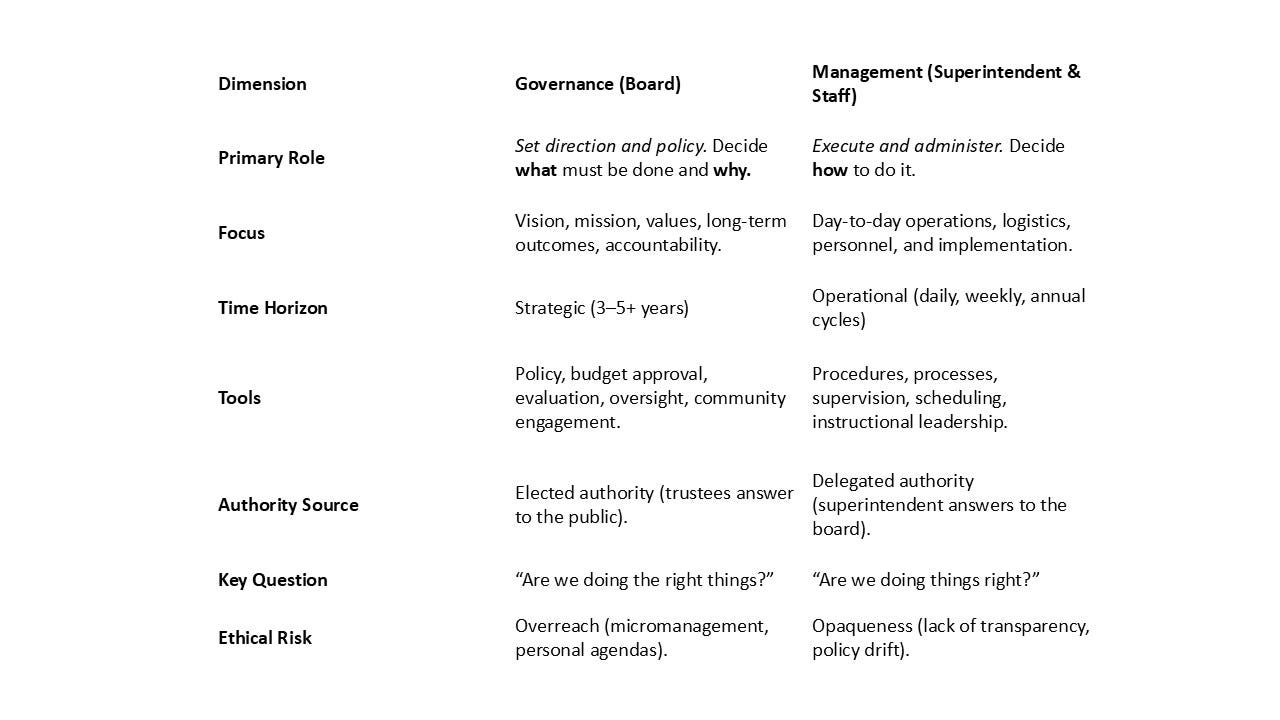
Now that we have an idea of what governance is and isn’t, what levers does a board have to effect outcomes? The answer: statutory levers, procedural (ethical) levers, strategic levers, and cultural levers.
Statutory Levers: These are powers which are explicitly granted by the State of Idaho, and are memorialized in Idaho Code <link>. They include budgetary oversight, curriculum adoption, policy oversight, and open meeting laws. These activities are the closest a board can (ethically) get to direct management of a school district. Checks and balances include elections, recalls, and State/Association oversight.
The statutory requirements a board is required to meet is the lowest possible standard that a board could be held to. In the context of this post, we will assume that a board will follow these standards by default, if for no other reason than staying out of jail! The real power a board has is found in the remaining levers, but low-performing (or even detrimental) boards generally stop here as far as appropriate levers of governance are concerned.
Ethical and Procedural Levers (Board Culture): These, when applied with a level of professionalism, ensure ethical application of a board’s authority. They include the understanding and separation of roles (governance vs. management), transparency and accountability, open deliberation, codes of ethics (board norms), and community engagement. A good board understands that, while these aren’t required by Idaho Code, there is only one way for five trustees to work well together—and that is through creating and adhering to a set of built-in procedures specifically designed to ensure the highest ethical process behind decision-making. The only checks and balances of these levers are elections, and maybe civil suits.
Think of the last board meeting you attended: were decisions fully vetted through conversation and the weighing of facts? How many times did the board openly connect the conversation to student outcomes? Before closing the conversation and voting, were trustees asked if there was any more discussion to be had? Were stakeholders engaged to bring differing perspectives? Ethical leadership is a conscious process and, when woven into the fabric of a board, can drastically improve student outcomes, community relations, school culture, and staff retention.
Strategic Levers: These, combined with the Ethical and Procedural Levers above, are the most powerful governance levers that a board has. Strategic planning is the only real way a board can “move the needle” in regards to student outcomes. A board can’t enter a classroom and guide a teacher into high-performing practices, but they can ensure that the education being provided focuses on the right outcomes for students. This is why I have driven the strategic planning process so openly: because our students must be given an education that is relevant for them in the world we live in. Unfortunately, there are no checks and balances for this lever other than elections and recalls, so if a board is not performing these correctly, a community must undergo a years-long process to replace underperforming trustees until they have a board who will prioritize long-term student success.
A board should define for the school/district the focus areas for education and then provide the resources to fulfill this order. This must include a vision to define what success looks like so everyone (including teachers, administration, the board, and the public) knows how the school is doing at any given moment. The space between where a district is today and the vision of success is where the strategic plan lives. The board is responsible for creating a vision of success (a framework, if you will) that is based on the wishes of parents, students, and the community. Staff then fills in the gaps to create a plan of action that marches the school toward the community-driven vision. Does your district/school have a clear, Long-Term Strategic Plan? How have your trustees contributed to that plan?
Cultural Levers: This ties in closely with Ethical Levers, but merits it’s own category. Culture includes values, and an emphasis on how things are done rather than simply doing the right things. If a desirable outcome is achieved for someone but harmed the education of other students, what it really the right thing to do? That’s a tough question to answer, and culture makes all the difference. Like values, culture determines what “doing the things” looks like when they are being done. If respectful deliberation is a board norm, it will likely become the norm for staff. Conversely, if backroom discussions for selfish gain are the board norm, they will also become the norm for staff. The board is the highest level of exemplary behavior for the district, and the attitudes and norms of the board will become deeply infused into the attitudes and the norms for school staff.
Culture is self-policing: when a strong, healthy culture is established, bad behaviors and tendencies will be weeded out without escalation or surprise. An example could be if a teacher is hired who would rather not perform at a high level for students, but the cultural norm is that teachers go out of their way to perform at high levels, the new teacher would likely determine on their own that this school is not a good fit for them. At the same time, if the culture is one of using influence through personal relationships to achieve selfish ends at the district level, good staff would likely burn out and move on quickly as the definition of success changes with every conversation had by others. Rather than staff having to follow a formal process, the culture alone creates results (like it or not).
Boards hold the power to directly impact the education of every single student, whether they know it or not. Boards are made up of trustees who are voted into office, and more often than not, elections are the only way to hold them accountable. My hope is that this email helps you understand how important trustees are, what they can and can’t ethically do, and what to look for when you evaluate candidates for elected office.
As always, I hope that this conversation continues—even if it’s not with me directly. Share this with your friends and family or, better yet, talk to them about these issues one on one. Evaluate the candidates on your ballot together, and do your best to make your decision with a complete set of facts. If you don’t feel like you have a complete set of facts, I am happy to provide those that I can. Reach out to the candidates/incumbents and have a meaningful conversation about governance and ask them what their vision is, and use their answers to determine whether or not it aligns with our community’s vision. Because elected bodies are tasked with the moral obligation to represent their electorate, the electorate should be having open and candid conversations about the people on the ballot.
Quick announcement: The next board meeting was changed due to an overlap with the Idaho School Board Association convention. The board meeting is November 5th, at 6:00pm. I hope to see you there.
Brad Howlett
You must be running for Commissioner??? I wish I was younger and healthy, we could do a lot together.. School board is the issue. I'm hoping Karen and Kathy get unseated.